Introduction
Physical vapor deposition (PVD) is a thin-film deposition technique in which a solid source material—commonly called a target—is physically transformed into atomic or molecular vapor within a vacuum environment, transported through a low-pressure gas phase, and condensed onto a substrate surface to form a film . Unlike chemical vapor deposition (CVD), which relies on chemical reactions at the substrate surface to produce the deposited material, PVD is dominated by physical processes: evaporation or sputtering, vapor transport, adsorption, and surface diffusion . Very few, if any, chemical reactions occur during a standard PVD process, with reactive sputtering being the notable exception where a reactive gas is intentionally introduced to form a compound film .
PVD occupies a critical position in semiconductor manufacturing because of its unparalleled versatility in depositing metals, alloys, and certain compounds that are difficult or impossible to deposit by CVD methods . Historically, PVD has been the workhorse for metallization steps—depositing aluminum, titanium, tantalum, titanium nitride, and copper seed layers—while CVD has been preferred for dielectric and silicon-based films due to superior conformality . The PVD family encompasses two principal techniques: evaporation, in which a solid or molten source is heated until it vaporizes, and sputter deposition, in which energetic ions generated in a plasma bombard a target and eject target atoms via momentum transfer . Today, sputtering is the dominant PVD technique, though evaporation remains in use for specialized applications .
The importance of PVD in semiconductor manufacturing stems from several inherent advantages . PVD offers lower deposition temperatures compared to CVD, reducing thermal stress between the coating and substrate—a benefit that is particularly valuable when depositing on temperature-sensitive structures . The technique also provides excellent compositional control, as the stoichiometry of sputtered films closely mirrors that of the target material, enabling the growth of multi-element compounds over large wafer areas . Furthermore, PVD operates at very low pressures, minimizing gas-phase collisions and contamination, which results in films with high purity and strong adhesion . For a broader overview of deposition as a category, see the physics and principles of deposition in semiconductor manufacturing .
Physics & Mechanism
Sputtering: Momentum Transfer and Ion–Solid Interactions
The fundamental physics of sputter-based PVD begins with the creation of a plasma, typically by introducing an inert gas such as argon into a vacuum chamber and applying a high voltage between two electrodes . The applied electric field accelerates free electrons, which collide with neutral gas atoms and ionize them, sustaining the plasma discharge . Positively charged ions—predominantly Ar⁺—are accelerated toward the negatively biased target (cathode) and bombard its surface with kinetic energies typically in the range of tens to hundreds of electron volts .
When an energetic ion strikes the target surface, it penetrates a few atomic layers and transfers momentum through a collision cascade to target atoms . If the transferred energy exceeds the surface binding energy of a target atom, that atom is ejected from the surface—a process governed by the linear collision cascade theory of ion–solid interactions . The number of atoms ejected per incident ion is termed the sputter yield, and it depends on the ion species, ion energy, target material, and angle of incidence . The ejected atoms, possessing kinetic energies on the order of a few to tens of electron volts, travel through the low-pressure gas phase toward the substrate .
Magnetron sputtering, the most widely used variant, introduces a magnetic field near the target surface that confines electrons in helical trajectories, dramatically increasing their path length and thus the ionization probability of the working gas . This confinement raises the plasma density and sputter rate while enabling stable discharge at lower pressures and voltages, which in turn reduces film contamination and thermal load on the substrate .
Evaporation: Thermal Vaporization
In evaporation-based PVD, the source material is heated in a high-vacuum chamber—initially pumped to pressures below 10⁻⁵ torr—until its vapor pressure becomes sufficient for atomic flux to reach the substrate . Resistance heating using a tungsten filament was historically common, but electron-beam (e-beam) heating has become preferred for microelectronics because it can achieve higher temperatures, accommodate a wider range of materials, and avoid contamination from metal filaments . The evaporated atoms travel in line-of-sight trajectories with relatively low kinetic energies compared to sputtered atoms, which generally results in lower film density and poorer adhesion than sputtered films . Evaporation offers higher deposition rates, making it suitable for thicker films and coatings with less stringent morphological requirements .
Adsorption, Surface Diffusion, and Film Growth
Regardless of whether atoms arrive via sputtering or evaporation, the subsequent film growth mechanism follows a common sequence of surface events: adsorption, surface diffusion, nucleation, and coalescence . When an atom impinges on the substrate, it may either reflect (desorb) or stick, depending on the sticking coefficient, which is influenced by the atom's kinetic energy, substrate temperature, and surface chemistry . Adsorbed atoms—termed adatoms—then migrate across the surface by thermally activated diffusion hops, seeking lower-energy sites such as kinks, steps, or grain boundaries .
The competition between the arrival rate of new adatoms and their surface diffusion length determines the film morphology . If adatoms have sufficient time and mobility to find low-energy sites before the next atomic layer arrives, the film grows in a layer-by-layer (Frank–van der Merwe) mode . If diffusion is limited—due to low substrate temperature, high arrival rate, or high activation barriers—adatoms cluster into three-dimensional islands (Volmer–Weber growth), leading to granular, porous films . The Ehrlich–Schwoebel barrier, an additional energy barrier for adatoms crossing step edges, further influences morphology by promoting mound formation and, in extreme cases, nanorod or columnar growth .
Kinetic Monte Carlo Modeling of Growth
The stochastic nature of adsorption, diffusion, and nucleation makes kinetic Monte Carlo (kMC) modeling a powerful tool for predicting PVD film morphology . In the kMC framework, the deposition surface is represented as a lattice, and each possible event—adsorption at a lattice site, diffusion hop to a neighboring site, or desorption—is assigned a rate based on Arrhenius-type expressions involving activation energy barriers and attempt frequencies . The system evolves in time by solving the transient Master Equation:
$$\frac{\partial p_j(t)}{\partial t} = \sum_{i \ne j} p_i(t) T_{ij} - \sum_{i \ne j} p_j(t) T_{ji}$$
where $p_j(t)$ is the probability of the system being in state $j$ at time $t$, and $T_{ij}$ is the transition rate from state $i$ to state $j$ . This framework bridges atomistic physics—rooted in Transition State Theory and statistical mechanics—with macroscopic film properties, enabling prediction of nucleation density, surface roughness, and growth mode transitions as functions of process conditions . For related insights on how deposition rate interacts with these kinetics, the reader may consult the dedicated discussion on rate fundamentals .
Process Principles
Pressure and Gas-Phase Transport
The working gas pressure in a PVD chamber directly governs the number of gas-phase collisions that sputtered or evaporated atoms experience during transport from target to substrate . At very low pressures, atoms travel in near-ballistic (line-of-sight) trajectories, arriving at the substrate with high kinetic energy and strong directionality . This promotes dense film growth and good adhesion but exacerbates step coverage problems on non-planar topographies, as shadowed regions receive little or no flux . As pressure increases, collisions thermalize the atom flux, reducing arrival energy and angular directionality; this can improve sidewall coverage in high-aspect-ratio features but may also lead to lower film density and increased gas incorporation . The trade-off between conformality and film density is therefore fundamentally controlled by pressure .
Substrate Temperature and Adatom Mobility
Substrate temperature governs adatom surface diffusion through an Arrhenius relationship: higher temperatures provide the thermal energy needed for adatoms to overcome diffusion activation barriers, increasing their diffusion length and promoting smoother, denser films with larger grains . Conversely, low substrate temperatures restrict adatom mobility, favoring island nucleation and fine-grained, columnar, or amorphous microstructures . In semiconductor manufacturing, thermal budget constraints—especially on devices with shallow junctions or temperature-sensitive layers—often limit the maximum substrate temperature, creating a fundamental tension between film quality and device integrity .
Ion Energy and Bombardment Effects
In sputtering PVD, the energy of ions bombarding both the target (determining sputter yield) and the substrate (affecting film densification) is a critical parameter . Higher ion energy at the target increases the sputter rate and the kinetic energy of ejected atoms . At the substrate, energetic particle bombardment—often enhanced by applying a substrate bias—compacts the growing film, densifies grain boundaries, and improves adhesion, but excessive bombardment introduces compressive intrinsic stress, resputters deposited material, and can damage underlying device structures . The directionality of this effect means that increasing ion bombardment energy monotonically increases film density and stress up to a threshold, beyond which defect generation and stress-related failures dominate .
Magnetic Field Configuration
In magnetron sputtering, the magnetic field distribution above the target determines the plasma confinement zone, the erosion profile of the target, and the uniformity of the atom flux arriving at the substrate . A well-designed magnetic field maximizes ionization efficiency and target utilization by confining electrons in an annular racetrack, but this also creates a non-uniform erosion pattern . Process engineers balance magnetic field strength and geometry to optimize the trade-off among deposition rate, thickness uniformity across the wafer, and target lifetime .
Angular Distribution of Incident Flux
The angular distribution of the atomic flux arriving at the substrate is a key parameter for step coverage in topographically patterned wafers . Monte Carlo simulations of PVD deposition onto nanowire and nanorod structures have demonstrated that a wider angular distribution of incident flux provides more conformal coatings around three-dimensional features, whereas a narrow, highly directional flux creates self-shadowing and poor sidewall coverage . This principle is especially relevant for passivation layer deposition and other conformality-critical steps, though PVD's inherently directional nature means it often falls short of the conformality achieved by CVD or atomic layer deposition (ALD) .
Challenges & Failure Modes
Step Coverage and Shadowing
Because PVD operates at very low pressures where gas-phase collisions are minimal, the atom flux arrives at the substrate with strong directionality, producing line-of-sight deposition . On planar surfaces this is advantageous, but on patterned topographies—vias, trenches, and contact holes—the raised features shadow adjacent sidewalls and bottoms, leading to poor step coverage, thinning at feature shoulders, and even pinch-off at the openings of high-aspect-ratio structures . This is a fundamental geometric limitation of PVD that cannot be fully overcome by process tuning alone, and it is the primary reason PVD is supplemented or replaced by CVD or ALD for conformal coverage in advanced nodes .
Intrinsic Stress and Film Cracking
Energetic bombardment during sputter deposition compacts the growing film and generates intrinsic stress—typically compressive in magnetron sputtering . While moderate compressive stress can improve film adhesion and resistance to crack propagation, excessive stress causes film delamination, substrate warpage, and in extreme cases, fracture of underlying brittle dielectric layers . The stress state is governed by the balance between atomic peening (which scales with ion energy and flux) and thermal stress (which arises from the coefficient of thermal expansion mismatch between film and substrate during cooling from deposition temperature) . Process engineers must therefore navigate a narrow window where the film is sufficiently dense and adherent without exceeding the stress tolerance of the device stack .
Resputtering and Composition Deviation
In reactive sputtering or when depositing alloys, the different constituent elements have different sputter yields and sticking coefficients, leading to composition shifts between the target and the deposited film . Additionally, energetic ion bombardment at the substrate can resputter previously deposited atoms, with lighter elements being preferentially removed, further skewing stoichiometry . This effect is particularly problematic for complex oxide deposition, where precise stoichiometric control is essential for functional properties such as ferroelectricity or piezoelectricity .
Contamination and Purity
Although the vacuum environment in PVD minimizes gas-phase contamination, sources of impurity persist . In e-beam evaporation, contaminant particles from the melted source material can be ejected and incorporated into the film, reducing purity . In sputtering, target purity, background gas composition, and chamber wall outgassing all contribute to film contamination . Residual oxygen or moisture can react with reactive metals (e (Engineering Practice).g., titanium, tantalum) during deposition, forming unwanted oxide phases that degrade electrical conductivity and barrier performance .
Plasma Monitoring and Process Control
Real-time monitoring of plasma state in PVD is essential for maintaining film consistency, yet conventional plasma probes are invasive—they perturb the plasma and become coated by the deposition process itself, eventually altering their diagnostic response . The planar multipole resonance probe (pMRP) represents an emerging solution by placing the sensor on the substrate side opposite the plasma, exploiting the electromagnetic field's ability to penetrate the dielectric substrate to monitor plasma parameters "through the wafer" without direct exposure . However, this approach has been validated only for limited plasma and coating systems, and its applicability to highly conductive coatings or thick dielectrics remains uncertain .
Technology Node Evolution
28 nm Node and Earlier
At the 28 nm planar CMOS node and earlier, PVD was the primary method for depositing metal interconnects, barrier layers, and seed layers . Titanium and titanium nitride barrier layers, tantalum and tantalum nitride barriers for copper metallization, and aluminum-based interconnects were all deposited by sputtering . The relatively large feature dimensions at these nodes meant that PVD's step coverage limitations were manageable, and the technique's high deposition rate and compositional control were decisive advantages . Sputter-deposited films provided adequate conformality for the contact and via geometries typical of 28 nm technology, and the intrinsic stress of these films was accommodated by the mechanical robustness of the device stack . The 28nm planar process flow exemplifies the integration of PVD metallization in a mature planar technology .
14 nm FinFET Node
The transition to 14 nm FinFET technology introduced three-dimensional transistor architectures with significantly higher aspect ratio fins and tighter pitch interconnects . This geometrical shift amplified PVD's step coverage challenges: the directional flux that was adequate for planar structures produced severe shadowing on fin sidewalls and in narrow gaps . As a result, PVD began to be supplemented by CVD-based barrier and seed deposition processes that offered superior conformality . Nevertheless, PVD retained a role for planar metallization layers, pad metallization, and certain applications where its high deposition rate and low thermal budget remained advantageous . The 14nm FinFET process flow illustrates how PVD steps coexist with CVD and ALD in a mixed-deposition integration scheme .
7 nm and Beyond
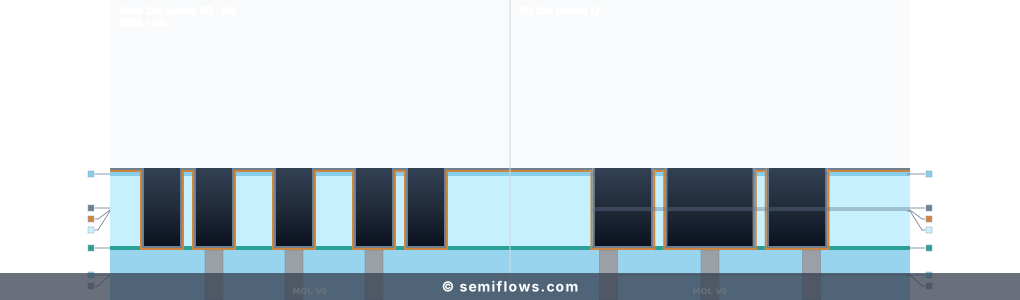
At 7 nm and advanced nodes, the scaling of interconnect dimensions to sub-20 nm pitches has pushed PVD to its fundamental limits . The ballistic, directional nature of PVD makes it increasingly difficult to achieve uniform coverage in the narrow, high-aspect-ratio features of advanced FinFET and Gate-All-Around (GAA) structures . For barrier and seed layers, atomic layer deposition and CVD have largely displaced PVD due to their superior conformality and thickness control at the atomic scale . However, PVD continues to serve in packaging-related metallization—particularly in forming under-bump metallization (UBM) layers for flip-chip interconnects, where its fast deposition speed, strong adhesion, and wide material range are leveraged . The 7nm FinFET process flow demonstrates this evolving division of labor between PVD and other deposition techniques .
In parallel, research into advanced PVD variants—such as high-power impulse magnetron sputtering (HiPIMS)—has sought to increase ionization fractions and produce more energetic, directional metal ion flux that can improve sidewall coverage in high-aspect-ratio features . Additionally, the integration of functional complex oxides onto silicon via oxide molecular beam epitaxy (MBE)—a PVD variant—remains an active research area for beyond-CMOS applications, though the slow growth rates and high costs of MBE limit its scalability . For complementary perspectives, the evolution of low pressure chemical vapor deposition and plasma enhanced chemical vapor deposition shows how chemical methods have risen to fill gaps that PVD cannot address at advanced nodes .
Related Processes
PVD does not operate in isolation; it is tightly integrated with adjacent process steps in the semiconductor fabrication sequence . Before PVD metallization, surfaces must be prepared by cleaning—often via sputter etching or cathodic cleaning, where voltage polarity is reversed to bombard the substrate with ions and remove native oxides and contaminants, ensuring strong adhesion of the subsequently deposited film . Following PVD barrier and seed deposition, electroplating or electrochemical deposition is typically used to fill the bulk of copper interconnects, as PVD alone cannot achieve the conformality and gap-fill required for narrow trenches .
PVD also interacts with CVD and ALD in hybrid integration schemes . For example, a sputter-deposited seed layer may be followed by an ALD-deposited barrier to achieve both adhesion and conformality . Similarly, in advanced packaging, PVD-deposited UBM layers serve as diffusion barriers and wetting layers for solder bumps, and their quality directly affects the reliability of subsequent reflow and underfill processes . The chemical vapor deposition family of processes—including metal organic chemical vapor deposition—often complements or competes with PVD depending on the specific material, feature geometry, and thermal budget constraints of the integration scheme .
In the broader context of thin-film manufacturing, flowable chemical vapor deposition and electroless deposition represent additional alternatives that address specific gaps—such as gap-fill in high-aspect-ratio dielectrics or selective metal deposition—where neither PVD nor conventional CVD is optimal .
Future Outlook
The future of PVD in semiconductor manufacturing is shaped by two divergent trends . On one hand, the continued scaling of transistor and interconnect dimensions favors chemical deposition methods (CVD, ALD) that offer atomic-level thickness control and superior conformality . On the other hand, PVD retains irreplaceable advantages in speed, material versatility, and adhesion that ensure its continued relevance for packaging, interconnect metallization, and emerging applications such as functional oxide integration .
Several research directions promise to extend PVD's utility . Advanced ionized PVD techniques, including HiPIMS and modulated pulsed power magnetron sputtering, aim to increase the metal ion fraction in the deposition flux, enabling better directional coverage and denser films at lower substrate temperatures . In-situ plasma monitoring tools such as the pMRP offer pathways to real-time process control that could improve film consistency and reduce defect-related yield loss . The combination of PVD with chemical vapor deposition in hybrid schemes—where PVD provides an initial seed or adhesion layer and CVD or ALD provides conformal fill—represents a pragmatic integration strategy that leverages the strengths of each technique .
For functional oxide integration on silicon, oxide MBE and pulsed laser deposition (PLD)—both PVD variants—remain research frontiers, particularly for beyond-CMOS devices exploiting ferroelectric, magnetic, or electro-optic properties . The challenge lies in scaling these lab-scale techniques to industrial wafer sizes while maintaining the nanoscale precision and epitaxial quality required for device functionality . As the semiconductor industry moves toward heterogeneous integration and three-dimensional packaging, PVD's role may shift increasingly toward interconnect and packaging metallization, where its fundamental physics—momentum-driven atom transport and energetic surface condensation—remains unmatched by chemical alternatives .