Introduction
Damage in semiconductor manufacturing refers to any unintended alteration of the crystalline lattice, material microstructure, or electrical properties of device layers caused by process operations . From the atomic displacement cascades triggered by ion implantation to the subsurface plastic deformation inflicted during chemical mechanical polishing (CMP), damage manifests across every stage of fabrication and at every relevant length scale—from individual lattice sites to full wafer warpage .
The importance of understanding and controlling damage cannot be overstated (Engineering Practice). As transistor dimensions have shrunk from the micrometer regime into single-digit nanometers, the fraction of device volume occupied by damaged material has grown dramatically . A damaged layer that was once a negligible fraction of a feature's cross-section now can consume a significant portion of critical dimensions, directly altering threshold voltages, carrier mobilities, leakage currents, and long-term reliability . In advanced interconnects, subsurface damage in copper from CMP creates residual defects that increase electromigration risk and degrade conductivity . In gate stack processing, plasma-induced charging damage injects charges through ultrathin dielectrics, generating traps that accelerate time-dependent dielectric breakdown (TDDB) . Even in advanced packaging, mechanical damage to glass core substrates during through-glass via (TGV) formation and singulation can initiate cracks that propagate under thermal cycling, causing catastrophic field failures .
This article provides a comprehensive examination of damage phenomena in semiconductor manufacturing, covering the fundamental physics, process interactions, failure modes, and the evolutionary trajectory as technology nodes scale toward angstrom-level dimensions .
Physics & Mechanism
Mechanical Damage: From Dislocations to Crystallite Fracture
The fundamental physics of mechanically induced damage in crystalline materials is governed by contact mechanics and crystal plasticity . When an abrasive particle or indenter applies a localized load to a crystalline surface, the resulting Hertzian contact stress field can exceed the theoretical shear strength of the material, nucleating dislocations at stress concentrators such as surface asperities or the contact point itself .
In face-centered cubic (FCC) metals like copper, plastic deformation proceeds via dislocation glide on {111} slip planes . Partial dislocation motion naturally generates stacking faults—planar defects where the regular ABCABC stacking sequence of close-packed planes is disrupted . As deformation continues, dislocations multiply, interact, and pile up, increasing the stored strain energy within the lattice . When this energy exceeds the lattice's capacity to accommodate further plastic flow through dislocation mechanisms alone, a fundamental transition occurs: localized lattice collapse and fragmentation produce broken crystallites, representing irreversible microstructural fracture .
In situ transmission electron microscopy (TEM) nanoindentation studies have directly visualized this hierarchical damage evolution in copper . At shallow indentation depths, damage consists primarily of dislocations and stacking faults—defects that can, in principle, be partially recovered through thermal annealing . Beyond a critical penetration depth, however, the dominant damage mode transitions to crystallite fracture, which is far more difficult to repair and leaves a permanently degraded subsurface layer .
Ion Implantation Damage: Cascade Physics and Amorphization
Ion implantation deliberately introduces dopant atoms into semiconductor substrates, but the process inevitably creates collateral damage through nuclear collision cascades . When an energetic ion enters the silicon lattice, it loses energy through two channels: electronic stopping (inelastic interactions with bound electrons) and nuclear stopping (elastic collisions with lattice atoms) . It is the nuclear stopping component that displaces silicon atoms from their lattice sites, creating Frenkel pairs—interstitials and vacancies .
Each displaced silicon atom can, in turn, possess sufficient kinetic energy to displace additional lattice atoms, producing a cascade of collisions . A single incident arsenic ion can create approximately one thousand displaced lattice atoms . The timescale of this damage production is extraordinarily brief: the ion comes to rest in roughly tens of femtoseconds, while thermal vibrations and elementary diffusion hops lead to partial recombination within nanoseconds . The residual primary damage consists of small defect clusters, dopant-defect complexes, and isolated interstitials and vacancies .
Damage accumulation from multiple implanted ions follows a complex trajectory . Some defects recombine with those from overlapping cascades, so the net damage depends on the existing local defect density . As implantation continues, damage builds until the crystal reaches a threshold defect density—often taken as approximately ten percent of the silicon lattice density—at which point amorphization occurs . Once amorphized, no channeling is possible and damage accumulation saturates (Engineering Practice). Notably, heavy ions like arsenic produce dense, localized damage cascades that allow more efficient within-cascade recombination, while lighter ions like boron produce more dispersed damage concentrated near the projected range where nuclear energy loss peaks .
Plasma-Induced Damage: Charging and Ion Bombardment
Plasma processes, essential for etching, deposition, and surface modification, introduce damage through two primary mechanisms: charging damage and ion bombardment damage .
Charging damage originates from the flow of conduction current through gate dielectrics when the plasma potential differs from the substrate potential . During plasma processing, the gate electrode of a metal-oxide-semiconductor (MOS) device can accumulate charge through the antenna effect—where floating metal interconnects connected to the gate collect charges from the plasma—and through the electron shading effect, where the flux difference between ions and electrons incident on topographic features creates local charging . This conduction current through the gate oxide generates defects at the dielectric bulk and the dielectric-silicon interface, altering tunneling currents, threshold voltages, and device reliability lifetime .
Ion bombardment damage arises when high-energy ions from the plasma sheath directly impact the silicon surface . The electric field in the plasma sheath accelerates ions toward the substrate, and upon impact, these ions can introduce lattice defects, strain, and an amorphized surface layer . This physical damage degrades junction leakage characteristics and increases sheet resistance in shallow junctions—effects that become increasingly severe as junction depths shrink .
Radiation Damage: Displacement and Trapping
Radiation damage, while primarily relevant to devices operating in harsh environments rather than during fabrication per se, shares fundamental physics with implantation damage . High-energy particles—protons, neutrons, heavy ions—deposit energy in semiconductor materials through non-elastic scattering and displacement interactions, creating vacancies, interstitials, and their complexes .
These radiation-induced defects act as charge trapping centers that reduce carrier lifetimes and shorten the mean drift path (schubweg) of electrons and holes . The relationship between radiation fluence and damage follows a linear trap introduction model, where the inverse schubweg increases proportionally with fluence . As trapping centers accumulate, charge collection efficiency degrades following the Hecht relation, which describes how the collected signal diminishes as the carrier drift length becomes comparable to or shorter than the detector thickness .
Process Principles
Ion Implantation: Energy, Dose, and Species Effects
The nature and extent of implantation damage are directionally governed by several key process parameters . Ion energy determines the penetration depth and the spatial distribution of damage—higher energies push the damage profile deeper but also spread it over a broader region . The ratio of nuclear to electronic stopping changes with energy: at higher energies, electronic stopping dominates initially, concentrating the nuclear damage near the end of range where the ion has slowed sufficiently .
Implant dose directly controls the accumulated defect density . At low doses, isolated damage cascades produce point defects and small clusters that can be substantially recovered through subsequent annealing . As dose increases, overlapping cascades fill in the damage profile and the local defect density rises toward the amorphization threshold . Once amorphization occurs over a continuous layer, further implantation adds no additional disorder within that amorphous region .
Ion species profoundly affects damage morphology through the mass-dependent nuclear stopping cross-section . Heavy species like arsenic deposit energy densely through nuclear collisions over a relatively short range, producing compact damage cascades with high local defect densities that can amorphize silicon at moderate doses . Light species like boron lose a larger fraction of their energy to electronic stopping, producing sparser, more dispersed damage that requires higher doses for amorphization and concentrates damage near the projected range .
Chemical Mechanical Polishing: Balancing Mechanical and Chemical Action
CMP achieves material removal through the synergistic interplay of mechanical abrasion and chemical reaction . The Preston equation provides the macroscopic framework—removal rate scales with pressure and relative velocity—but at the nanoscale, the interaction between abrasive particles and the work surface determines the damage state .
The fundamental principle for minimizing CMP-induced damage is to reduce the mechanical contribution to material removal by enhancing the chemical contribution . Chemical oxidants (such as hydrogen peroxide) convert the metal surface into a softer oxide layer that can be removed at lower mechanical loads . Chelating agents (such as polyaspartic acid or aspartic acid) complex with dissolved metal ions to prevent re-deposition, ensuring that the generate-remove-regenerate cycle proceeds efficiently .
Abrasive particle size and dispersion critically influence the stress distribution at the wafer surface . Well-dispersed nanospheres provide uniform, scale-controlled mechanical abrasion that removes only the topmost atomic layers, significantly reducing plastic deformation and subsurface damage compared to larger, irregularly shaped abrasives . When the effective penetration depth of abrasives remains below the critical depth for crystallite fracture, the damaged layer is confined to minor stacking faults and dislocations rather than severe subsurface fracture .
Plasma Processing: Power, Pressure, and Bias Interactions
Plasma-induced damage is directionally controlled by the interplay of plasma parameters . Radio frequency (RF) power influences plasma density and ion flux—higher power increases both the ion current available for charging damage and the ion bombardment rate for physical damage . However, the relationship is nuanced: higher plasma density can also reduce sheath voltage, partially offsetting the increased ion flux .
Pressure affects the mean free path and energy distribution of ions traversing the sheath (Engineering Practice). At higher pressures, collisions within the sheath thermalize the ion energy distribution, reducing the fraction of high-energy ions capable of causing deep physical damage . Conversely, low-pressure plasmas produce more monoenergetic ion energy distributions with higher peak energies .
Substrate bias directly controls the ion energy at the substrate surface . Higher bias voltages accelerate ions to greater energies, increasing both the sputtering yield and the depth of physical damage in the near-surface region . For gate dielectric integrity, the antenna ratio—defined as the ratio of the collecting interconnect area to the gate area—amplifies charging damage by collecting more plasma current per unit gate dielectric area .
Intentional Damage for Stress Engineering
An emerging paradigm treats damage not as a purely deleterious phenomenon but as a controllable process variable for stress engineering . Selective area damage using ion beams can locally modify the microstructure and intrinsic stress of thin films . When an ion beam displaces atoms from crystalline positions, induces amorphization, or changes stoichiometry, the local stress state of the film is altered—typically reduced . By varying the ion beam duty cycle, scan speed, or dose distribution across the substrate, a spatially non-uniform stress compensation layer can be patterned without physical masks, enabling precision warpage control .
This approach leverages the Stoney equation, which relates thin-film stress to wafer curvature . By selectively reducing stress in regions that contribute to excessive warpage, the global curvature of the wafer can be brought within specification . The process requires accurate wafer surface stress or topography mapping; otherwise, compensation may be insufficient or excessive .
Challenges & Failure Modes
Gate Dielectric Degradation from Plasma Charging
One of the most insidious failure modes associated with damage is the progressive degradation of gate dielectric reliability . Charging damage injects carriers through the gate oxide, generating bulk and interface traps that manifest as threshold voltage shifts and increased leakage . Critically, the direction of threshold voltage shift depends on the dielectric material: in p-channel MOS devices with silicon dioxide gate dielectrics, plasma exposure shifts the threshold voltage negatively, while the same exposure on high-k gate dielectrics (such as hafnium aluminate on silicon dioxide) shifts it positively . This opposite behavior arises from fundamental differences in trap generation and carrier capture mechanisms between the two material systems .
The antenna effect amplifies this damage in real circuit layouts . Long interconnect traces connected to small gate electrodes act as charge collectors, funneling disproportionate plasma currents through the gate dielectric . The electron shading effect compounds this in high-aspect-ratio features, where the different mobilities of ions and electrons in the plasma create local charging of conductor surfaces . Both mechanisms mean that damage is not uniform across a chip—certain device geometries are disproportionately affected, creating reliability weak points that may not be caught by standard test structures .
Subsurface Damage in Copper Interconnects
CMP of copper interconnects presents a persistent challenge because the soft, plastic nature of copper makes it susceptible to subsurface damage from abrasive contact . The hierarchical progression from dislocations to stacking faults to broken crystallites means that the damage state is highly sensitive to process conditions . Lapping with hard abrasives on silicon carbide plates produces severe damage layers containing fractured grains, grain boundaries, moiré fringes, lattice distortion regions, superlattice structures, and edge dislocations . Even mechanical polishing with finer ceria abrasives leaves a damaged layer with a complex mixture of defects .
The challenge is that residual subsurface defects act as electromigration nucleation sites and increase effective resistivity . In damascene structures, where the copper fill is already constrained by narrow trench geometries, additional lattice defects from aggressive CMP can significantly impact the interconnect performance that single damascene integration schemes are designed to achieve . Achieving atomic-level flatness with minimal damage requires the chemical component of CMP to sufficiently soften the surface before mechanical abrasion, maintaining the effective abrasive penetration depth below the critical threshold for crystallite fracture .
Ion Implantation Amorphization and Transient Enhanced Diffusion
When implantation damage exceeds the amorphization threshold, the resulting amorphous layer poses significant challenges for subsequent processing . During thermal annealing, the recrystallization of amorphous silicon proceeds through solid-phase epitaxial regrowth (SPER), but the process is imperfect . The regrown crystal typically contains a high density of extended defects—particularly {311} defects and dislocation loops—formed from the excess interstitials left behind after recrystallization .
These residual interstitials drive transient enhanced diffusion (TED), where dopant atoms—especially boron—diffuse orders of magnitude faster than equilibrium predictions during the early stages of annealing . TED occurs because the excess interstitials from implantation damage interact with dopant atoms through the kick-out mechanism, where a silicon interstitial displaces a substitutional boron atom into an interstitial position from which it diffuses rapidly . This phenomenon makes it extremely difficult to achieve abrupt, shallow junction profiles in advanced devices, directly impacting the source drain recess engineering that defines short-channel electrostatics .
Glass Core Damage in Advanced Packaging
The adoption of glass core substrates in advanced packaging introduces a new category of damage challenges . Glass has a high elastic modulus but low fracture toughness, making it susceptible to crack initiation at stress concentrations such as edges, corners, and via sidewalls . During fabrication of through-glass vias, patterning, and singulation, stresses produced in the glass can result in SeWaRe (separation/wafer/record) defects—tears or splits in the glass layer—and dielectric delamination at glass-dielectric interfaces .
The fundamental challenge is that glass edge defects propagate readily under the thermo-mechanical stresses of packaging and field operation . Unlike organic substrate materials that can yield plastically, glass fails catastrophically once a crack reaches critical length . The mismatch in coefficients of thermal expansion between glass and adjacent dielectric or buffer layers creates interfacial stresses during thermal cycling that can drive delamination and crack propagation .
Technology Node Evolution
The 28nm Era: Managing Known Damage Mechanisms
At the 28nm planar node, damage was already a significant concern but was largely manageable through established techniques . Gate oxides were thick enough (relative to later nodes) that charging damage during plasma processing could be contained within acceptable reliability margins, though the antenna effect required careful layout design rule enforcement . Ion implantation damage was addressed through well-characterized rapid thermal annealing (RTA) sequences that achieved sufficient dopant activation while minimizing TED . CMP damage in copper interconnects was present but represented a small fraction of the overall line cross-section .
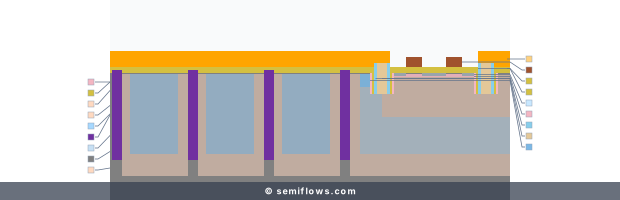
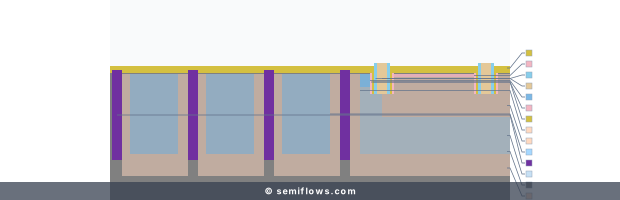
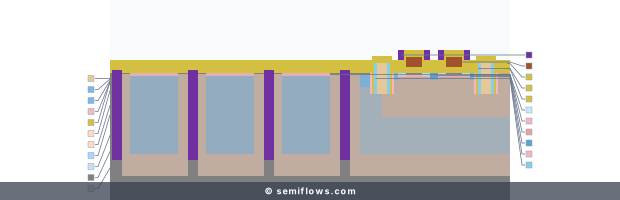
The 28nm Planar Flow represents the culmination of planar device scaling where damage, while important, had not yet become a first-order limiter . The critical dimensions were large enough that damaged layers could be tolerated as a fraction of feature size, and the material systems (SiO2 gate dielectrics, standard copper damascene) were well understood .
The 14nm FinFET Transition: Three-Dimensional Damage Challenges
The transition to FinFET architecture at the 14nm node introduced fundamentally new damage challenges . The three-dimensional fin structures created high-aspect-ratio features that amplified plasma-related damage through the electron shading effect . During gate spacer deposition and fin patterning, plasma processes exposed these narrow vertical features to directional ion fluxes that could charge fin sidewalls non-uniformly, generating localized electric fields across gate dielectrics that were now wrapped around three surfaces of the fin .
The 14nm FinFET flow required careful management of fin damage during fin cut trench formation and subsequent cleaning . Any crystal damage to the fin sidewalls directly degrades carrier mobility in the channel, because the conduction in a FinFET occurs primarily along these vertical surfaces . The transition to high-k/metal gate stacks also introduced new dielectric damage sensitivities: hafnium-based dielectrics exhibit fundamentally different trap generation and carrier capture behavior compared to SiO2, requiring process adjustments to plasma conditions .
Additionally, the narrower fin geometries made implantation damage more consequential . Self-aligned implant steps had to be carefully controlled to avoid amorphizing the fin structures, as SPER of amorphized fins can produce defective crystals with degraded mobility . Pre-amorphization implants, sometimes used to control channeling, had to be eliminated or replaced with alternative approaches (Engineering Practice).
The 7nm Node and Beyond: Atomic-Scale Damage Budgets
At the 7nm node and beyond, damage budgets have become measured in atomic layers (Engineering Practice). The 7nm FinFET flow operates with fin widths on the order of a few nanometers, meaning that even a one-nanometer damaged layer on each sidewall consumes a substantial fraction of the conducting channel . Gate dielectric equivalent oxide thicknesses approaching the sub-nanometer regime mean that a few additional interface traps from plasma charging can dominate threshold voltage and reliability characteristics .
Copper interconnect dimensions at these nodes have reached the point where grain boundary scattering and surface roughness dominate resistivity . Any residual CMP damage that increases surface roughness or introduces near-surface lattice defects directly contributes to the resistivity increase that is already a major challenge at these dimensions . The work on achieving atomic-level flatness through optimized CMP chemistry—with damaged layers as thin as a few stacking faults—represents the direction that all CMP processes must evolve .
The introduction of extreme ultraviolet (EUV) lithography has partially mitigated some damage sources by reducing the number of plasma etching steps required for multi-patterning, but has introduced new concerns around photoresist-related contamination and the damage implications of the high-energy photon exposure itself . In advanced packaging, the shift toward glass core substrates for heterogeneous integration has introduced the damage management challenges described earlier—crack initiation, SeWaRe defects, and interface reliability .
Related Processes
Surface Cleaning and Damage Removal
Post-process surface cleaning is intimately connected to damage management (Engineering Practice). Wet cleaning steps following plasma etching must remove polymer residues and oxidized damage layers without introducing additional damage through chemical attack or mechanical force . The surface cleaning processes must be tuned to remove the specific damage species present—whether plasma-deposited polymers, native oxides grown on damaged surfaces, or metallic contaminants from etching or CMP—while preserving the underlying crystalline integrity .
Epitaxial Growth on Damaged Substrates
Selective epitaxial growth used for source/drain engineering is highly sensitive to substrate damage . Nucleation of epitaxial layers on damaged or amorphized silicon produces defective crystals with high defect densities . The quality of the epitaxial growth directly depends on the crystalline quality of the exposed silicon surface, which means that pre-epitaxy cleaning and surface preparation must effectively remove any residual implantation or plasma damage to achieve defect-free selective growth .
Nucleation Layers and Interface Quality
The quality of subsequently deposited layers depends critically on the damage state of the underlying surface . A nucleation layer deposited on a damaged substrate may exhibit altered nucleation density and film morphology, propagating the damage influence through multiple layers . In copper damascene processing, the condition of the trench surface after CMP and cleaning determines the quality of the diffusion barrier and seed layer nucleation, directly affecting electromigration performance .
Stress Engineering Through Pattern Memorization
Damage-induced stress modifications connect to the broader topic of pattern memorization and stress engineering in advanced CMOS . The selective area damage approach using ion beams demonstrates that controlled damage can be harnessed as a tool for managing wafer-level stress distributions, complementing traditional stress memorization techniques used to enhance carrier mobility in transistor channels .
Future Outlook
The trajectory of damage management in semiconductor manufacturing is evolving in several key directions . First, the drive toward atomic-precision manufacturing demands that damage budgets shrink correspondingly . The achievement of atomic-level flatness in copper CMP with damaged layers consisting only of minor stacking faults points toward a future where damaged layers must be sub-nanometer or eliminated entirely through process optimization .
Second, the intentional use of damage as a process tool—exemplified by selective area stress compensation—represents a paradigm shift . Rather than treating damage purely as a defect to be minimized, advanced processes will increasingly leverage controlled damage as a means of tuning material properties . This requires deep understanding of the dose-response relationships between ion beam exposure, microstructural modification, and resulting stress states .
Third, the integration of new materials and architectures continues to introduce new damage modes . Glass core substrates in advanced packaging, wide-bandgap semiconductors for power electronics, and two-dimensional materials for beyond-CMOS devices each present unique damage physics that must be characterized and managed . The radiation damage studies in CVD diamond demonstrate that even materials selected for their radiation hardness experience progressive degradation under extreme fluence, governed by the same fundamental displacement damage physics that affects silicon—albeit at different threshold energies .
Finally, the development of in situ and in operando characterization techniques—such as the TEM nanoindentation approach that directly visualized dislocation nucleation and crystallite fracture in copper—will become increasingly important for understanding damage at the atomic scale . These techniques bridge the gap between atomistic simulations and macroscopic process observations, providing the physical insight needed to develop truly damage-free processes for future technology nodes .