Introduction
Planarization is the set of processes used in semiconductor manufacturing to reduce or eliminate surface topography—step heights, trenches, protrusions, and other uneven features—created by preceding deposition, etch, and patterning steps . As integrated circuits are built layer upon layer on a silicon substrate, each new deposition conforms to the existing surface profile, and any unevenness propagates and often amplifies through subsequent levels . A large step height on one level can lead to thinning of the next level on sidewalls, cusping, overhangs, and even worse coverage problems on subsequent levels . The purpose of planarization is to interrupt this propagation, restoring a flat or nearly flat surface so that the next photolithography, etch, and deposition steps can proceed with the precision that the device design demands .
The degree of planarization (DOP) is formally defined as one minus the ratio of the final step height after planarization to the initial step height before planarization . A DOP approaching unity means the step has been essentially eliminated; a DOP near zero means the surface remains as uneven as before (Engineering Practice). It is important to distinguish between local planarization—flattening over distances on the order of individual features or metal pitches—and global planarization, which addresses topography across the entire wafer or at least across entire chip-scale fields . Many early planarization techniques achieved good local smoothing but could not flatten global topography, which became increasingly problematic as lithography depth of focus budgets tightened .
A flat surface is highly desirable in integrated circuit (IC) processing because it greatly improves subsequent optical lithography—ensuring the entire exposure field stays within the depth of focus—and improves etch uniformity . Without planarization, the cumulative topography built up over multiple metal interconnect layers would make high-resolution photolithography impossible . For this reason, planarization—especially chemical mechanical planarization (CMP)—may be performed not only in the back-end interconnect process but also in the front-end, for example in the formation of shallow trench isolation .
Physics and Mechanism
Chemical Mechanical Planarization: Synergistic Removal
The dominant planarization method in modern semiconductor manufacturing is CMP, which achieves material removal through the synergistic action of chemical reactions and mechanical abrasion . In a CMP process, a wafer is held in a rotating carrier and pressed against a rotating polymeric pad onto which an aqueous slurry is dispensed . The slurry contains nanoscale abrasive particles—typically silica, ceria, or alumina—along with chemical additives such as oxidizers, complexing agents, and inhibitors .
The fundamental physics of CMP can be understood through the lens of tribology and contact mechanics . The material removal rate (MRR) follows Preston's law, which states that MRR is directly proportional to the applied contact pressure and the relative velocity between the pad and wafer . Physically, the pad asperities press abrasive particles against the wafer surface under the applied load . In the asperity contact region, both two-body abrasion—direct contact between wafer and pad—and three-body abrasion—contact among wafer, pad, and abrasive particle entrained in the slurry film—can occur .
The chemical component of CMP softens the wafer surface by forming a reacted layer that is mechanically weaker than the bulk material . For example, oxidizers convert metal surfaces into metal oxides or hydroxides that are more easily abraded; complexing agents dissolve reaction products into the slurry; inhibitors protect recessed areas from chemical attack, enhancing selectivity . Under ideal conditions, this reacted layer is uniformly removed by the nanoscale abrasives under mild contact, producing a smooth, flat surface . The chemical reactions continuously regenerate the softened layer as mechanical abrasion removes it, establishing a steady-state removal process .
Colloidal Stability and Slurry Physics
The stability of the slurry is governed by colloidal science, specifically DLVO theory, which describes the balance between van der Waals attractive forces and electrostatic repulsive forces between particles . The pH of the slurry determines the surface potential of the abrasive particles, thereby controlling the electrostatic repulsion . When repulsion is sufficient, particles remain dispersed; when repulsion is insufficient, particles agglomerate into large particles or large particle counts (LPC), which are a primary cause of micro-scratches during polishing . The rheological behavior of the slurry—its viscosity and shear-thinning or shear-thickening characteristics—affects the real contact area and friction coefficient at the pad–particle–wafer interface, thereby modulating the material removal rate .
Etch-Back Planarization
An alternative planarization mechanism involves etch-back . In this technique, a dielectric is deposited, sometimes followed by deposition of a sacrificial layer such as photoresist . The sacrificial layer is spun over the oxide, filling spaces and producing a nearly flat top surface (Engineering Practice). After a hardbake, an etch is performed that removes both the oxide and photoresist at ideally the same rate; when the bottom of the photoresist is reached, a nearly flat oxide surface remains . This approach achieves local planarization but only limited global planarization . Plasma etching, argon sputtering, or CMP can all be used for the etch-back step .
A variant of etch-back planarization uses dry-film photoresist lamination followed by reactive ion etch-back . The dry film is laminated under heat and pressure, exploiting the plastic flow of the polymer to span deep steps macroscopically . A subsequent quasi-isotropic plasma etch precisely thins the film, maintaining continuous coverage while achieving a surface suitable for high-resolution lithography . The key physical principles include thermally enhanced adhesion and flow of the polymer film, controllable reactive ion etching of organic materials, and suppression of micromasking effects that would otherwise produce grass-like roughness .
Vacuum Planarization in Patterned Media
In patterned magnetic recording media, etching islands from a continuous magnetic film introduces intrinsic surface roughness . Vacuum planarization addresses this by first depositing a conformal carbon layer over the patterned surface, then applying an argon plasma with high inductively coupled plasma (ICP) power and low bias . The argon ions preferentially sputter carbon from protrusions—where the carbon is more exposed to the plasma—re-distributing material from peaks into valleys . As etch-back time increases, the surface initially becomes smoother; however, when the carbon on top of the islands is fully removed, the plasma begins etching the magnetic material faster than the remaining carbon in grooves, causing roughness to increase again with over-etching . This non-monotonic behavior illustrates a fundamental trade-off in ion-based planarization: there exists an optimal process window beyond which further etching degrades rather than improves flatness .
Imprint and Catalytic Planarization
Newer planarization approaches include imprint-based methods, where a curable planarizing material is pressed against a flat mold surface . The material flows under external force and mold constraint to fill substrate steps, and after curing—by ultraviolet light or heat—the mold surface morphology is transferred to the planarization layer . The physics here is one of viscous flow and capillary filling under pressure, followed by photopolymerization that "freezes" the flat morphology . A dual-layer approach can isolate defects: a first layer using a lower-performance planarizing component performs initial leveling, and a second, higher-performance layer corrects residual defects transferred from the first .
Catalysis-assisted planarization represents yet another mechanism . A transition metal catalytic layer on the polishing pad surface activates chemical species in a liquid medium to react with workpiece surface atoms—particularly effective for hard, brittle materials like silicon carbide (SiC) and gallium nitride (GaN)—producing soluble or weakly adhered reaction products that are removed at the atomic scale . By combining rotation of one element with reciprocating linear motion of the other, the reaction locations are spatially averaged, improving overall uniformity .
Process Principles
Pressure and Velocity
According to Preston's law, the material removal rate increases linearly with both applied downward pressure and relative pad–wafer velocity . Increasing pressure directly increases the real contact area between pad asperities and the wafer surface, driving more abrasive particles into effective contact and increasing the mechanical removal component . However, excessive pressure increases the risk of scratching, delamination, and non-uniform removal due to edge effects and wafer bow . Increasing velocity increases the number of abrasive contact events per unit time and improves slurry refresh at the interface, but it also raises the frictional temperature and can destabilize the hydrodynamic lubrication regime, transitioning from benign three-body abrasion to damaging two-body contact .
Slurry Chemistry and Particle Characteristics
The chemical composition of the slurry directionally controls removal selectivity and surface quality . Increasing oxidizer concentration accelerates the formation of the softened reaction layer, raising the chemical contribution to removal; however, excessive oxidation can cause corrosion, pitting, or non-selective etching of recessed areas . Complexing agents increase the solubility of reaction products, preventing redeposition and improving removal rate; inhibitors selectively protect certain materials or recessed regions, enhancing planarization efficiency—the ratio of removal rate at high features to that at low features .
Abrasive particle size has a direct effect on removal rate and defectivity . Larger particles increase the mechanical removal component but also increase the probability and severity of scratches . Particle morphology—spherical versus angular—affects the contact stress distribution: angular particles concentrate stress at edges and corners, increasing the risk of brittle fracture in the wafer film . Surface charge, controlled by pH, determines colloidal stability; moving pH away from the isoelectric point increases electrostatic repulsion and reduces agglomeration .
Pad Condition and Topography
The polishing pad is a critical element whose surface microstructure directly determines the real contact area and slurry transport efficiency . Pad asperities—generated and maintained by diamond conditioning—create the local pressure distribution that drives preferential removal of high features . As polishing proceeds, pad pores can become clogged with polishing residues—a phenomenon called glazing—which reduces slurry transport and causes non-uniform removal . Diamond conditioning excises the pad surface to maintain its roughness against plastic deformation and prevent glazing . Insufficient conditioning leads to pad glazing and reduced removal rate; excessive conditioning can strip too much pad material, shortening pad life and altering the pressure distribution .
Etch-Back Process Parameters
In etch-back planarization, the ratio of etch rates between the sacrificial layer and the underlying dielectric is critical . If the sacrificial layer etches faster, it is consumed before the underlying topography is leveled, leaving residual steps; if it etches slower, the underlying material is exposed prematurely, creating new topography . In plasma-based etch-back, gas chemistry ratios, radio frequency (RF) power, and chamber pressure determine the etch rate, isotropy, and uniformity . Micro-masking—where non-volatile residues locally protect the surface—must be suppressed to prevent grass formation and maintain surface smoothness .
Challenges and Failure Modes
Micro-Scratches
Micro-scratches are among the most prevalent and consequential defects in CMP . They arise from a synergistic imbalance between chemical softening and mechanical abrasion . Under normal conditions, abrasive particles in the slurry operate in a three-body abrasion regime, rolling or sliding between the pad and wafer while removing the chemically softened reaction layer . However, when rogue large particles—arising from slurry agglomeration, pad debris, or environmental contamination—are present, or when local contact stress exceeds the fracture threshold of the wafer film, the abrasion regime transitions to severe two-body abrasion or plowing . This induces plastic deformation, micro-cracking, or brittle fracture in the film, producing scratches that can propagate through subsequent layers and cause device failure . The probability of scratching increases with abrasive particle size, polishing pressure, and pad roughness anomalies .
Dishing and Erosion
Dishing occurs when a soft material—such as copper in a damascene structure—is over-polished relative to the surrounding hard dielectric, creating a concave depression in the metal line . Erosion is the complementary loss of dielectric material in dense pattern regions . Both arise from the lack of perfect selectivity in the CMP process: the polishing pad deflects into recesses, and the chemical environment attacks exposed materials differentially . The physics is governed by the pad's elastic modulus and the pattern density dependence of the real contact pressure . Higher pattern density increases local pressure on the dielectric, accelerating erosion; wider metal lines increase the span over which the pad can deflect, increasing dishing .
Film Delamination
Film delamination occurs when the interfacial adhesion between the polished film and the underlying layer is insufficient to withstand the mechanical shear stresses imposed during CMP . The shear stress at the interface is proportional to the friction coefficient and the applied normal pressure . Chemical attack can also weaken the interface by degrading adhesion promoters or barrier layers . Delamination is particularly problematic when polishing low-density dielectric films, which have lower mechanical strength and stiffness than dense silicon dioxide .
Residual Defects in Non-CMP Planarization
In imprint-based planarization, defects in the planarizing mold surface—scratches, contaminants, or adhered cured composition—can transfer to the planarization layer . If the first planarization layer has defects too large or too deep, the second layer may not fully correct them, leading to residual flatness variations that cause photolithography depth-of-focus mismatch . In vacuum ion planarization, over-etching beyond the optimal window causes the plasma to attack the underlying magnetic material faster than the residual filler in grooves, increasing rather than decreasing roughness .
Corrosion
Metal corrosion during CMP arises when the chemical environment is too aggressive relative to the mechanical removal rate . If the oxidizer concentration is too high or the inhibitor concentration is too low, the chemical reaction penetrates beyond the softened surface layer into the bulk metal, particularly at grain boundaries or other chemically active sites . This produces pitting, staining, or galvanic corrosion at interfaces between dissimilar metals .
Technology Node Evolution
28 nm and the Transition to Copper Damascene
At the 28 nm node, planarization was already firmly established as a critical back-end process . The 28 nm planar flow relied heavily on CMP for copper damascene interconnect formation: trenches were etched in the dielectric, a barrier liner and copper seed were deposited, electroplated copper filled the trenches, and CMP removed the excess metal to leave inlaid metal lines . At this node, the primary planarization challenge was achieving adequate copper-to-dielectric selectivity and controlling dishing and erosion across varying pattern densities . The chemical mechanical planarization process was mature, but slurry and pad optimization remained critical for yield .
Shallow trench isolation (STI) CMP was also well-established at 28 nm, using a reverse-mask approach where silicon nitride served as a polish stop . The pre-metal dielectric planarization step ensured that the dielectric surface above active devices was sufficiently flat for the first metal contact lithography .
14 nm: FinFET and New Planarization Requirements
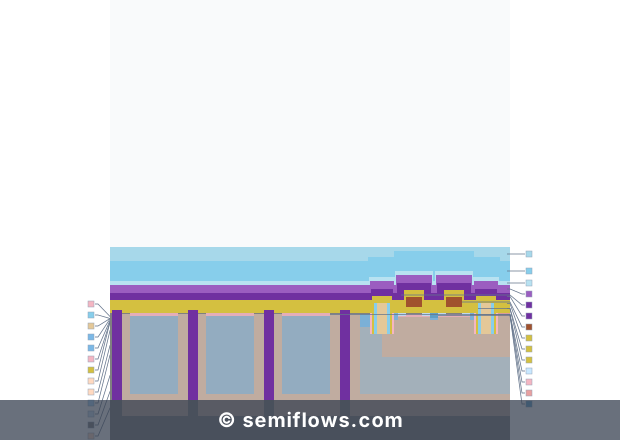
The transition to 14 nm FinFET technology, as illustrated in the 14 nm FinFET flow, introduced new planarization challenges . The three-dimensional fin structures created significant topography that had to be planarized during STI formation (Engineering Practice). The poly open polish step became critical: after depositing polycrystalline silicon gate material conformally over the fins, CMP was used to remove excess polysilicon and expose the underlying dielectric, defining the gate pattern without lithographic etch . This required extremely high selectivity between polysilicon and the underlying oxide-nitride stack .
At 14 nm, the number of metal interconnect layers increased, and each layer required CMP planarization . The over polishing margin—the tolerance for removing more material than nominally required—became tighter because the remaining film thicknesses were smaller and the cumulative effect of dishing and erosion on RC delay became more significant .
7 nm and Beyond: Multi-Patterning and Atomic-Scale Control
At 7 nm, as shown in the 7 nm FinFET flow, the challenges intensified . Contact hole patterning relied on self-aligned double patterning, which deposited and planarized multiple spacer layers . Each planarization step had to preserve critical dimensions while removing excess material with sub-nanometer uniformity . The cmp slurry abrasive particle size distribution became a dominant factor in defectivity: as feature sizes shrank below the abrasive particle diameter, the probability of a single particle bridging multiple features and causing localized over-removal increased .
Beyond 7 nm, new channel materials such as SiC and GaN for power devices and future logic applications require planarization of chemically inert, mechanically hard surfaces . Traditional CMP struggles with these materials because the chemical reaction rates are low and the mechanical loads required for removal risk introducing sub-surface damage . Catalysis-assisted planarization, which activates chemical reactions through transition metal catalysis at the pad surface, offers a path to atomic-scale removal without mechanical damage . Similarly, imprint-based dual-layer planarization provides an alternative for applications where CMP chemistry cannot be sufficiently tuned .
Related Processes
Planarization does not exist in isolation; it is deeply coupled with adjacent process steps . Immediately preceding planarization is the deposition step—whether dielectric chemical vapor deposition (CVD), metal electroplating, or spin-on polymer coating—that creates the film to be planarized . The conformality, density, and stress state of that deposition directly determine the initial topography and the planarization challenge . For instance, a highly conformal CVD oxide over high-aspect-ratio features will have deep valleys that are difficult to fill by planarization alone; a spin-on dielectric may flow into valleys but may shrink during cure, creating new topography .
Following planarization, the most critical adjacent step is photolithography . The entire purpose of planarization is to bring the wafer surface within the depth of focus of the exposure tool . The active area definition, gate patterning, and contact hole lithography all depend on the planarity achieved by preceding CMP or etch-back steps . Residual topography beyond the lithography budget causes line-width variations, resist thinning, and ultimately pattern failure .
Etch processes also depend on planarity . Non-uniform surface height leads to non-uniform etch depth because the plasma sheath and ion trajectories vary with local topography . In damascene integration, after single damascene trench etch and metal fill, the CMP planarization step defines the final metal height and thus the line resistance and parasitic capacitance .
The photoresist removal step that follows lithography and etch must also be considered in the context of planarization: if photoresist residues are not fully removed, they can act as micro-masks during subsequent etch-back planarization, producing grass-like defects . Conversely, aggressive photoresist removal can attack the freshly planarized surface, reintroducing topography .
Future Outlook
The future of planarization is being shaped by several converging trends (Engineering Practice). First, as device dimensions approach single-digit nanometers, the abrasive particle size in CMP slurries becomes comparable to or larger than the features being polished, fundamentally changing the contact mechanics . Research is progressing toward sub-nanometer abrasive particles, abrasive-free chemistries, and catalyst-assisted planarization that rely primarily on chemical activation rather than mechanical abrasion .
Second, new materials—wide-bandgap semiconductors like SiC and GaN, two-dimensional materials, and novel low-k dielectrics—each present unique chemical and mechanical challenges that require tailored planarization chemistries . The pattern memorization phenomenon, where underlying pattern density variations propagate through planarized layers and affect subsequent processing, is becoming a critical yield limiter at advanced nodes and requires co-optimization of deposition, planarization, and patterning .
Third, the integration of artificial intelligence and real-time metrology into CMP tools promises closed-loop control of removal uniformity, potentially reducing the reliance on empirical process window definition . In situ sensing of friction force, acoustic emission, and optical endpoint detection can provide real-time feedback on the state of the pad–wafer interface, enabling dynamic adjustment of pressure and velocity to maintain optimal planarization conditions .
Finally, the environmental impact of CMP—water consumption, slurry waste, and chemical disposal—is driving research into waterless or near-waterless planarization processes, including vacuum ion planarization and catalytic dry planarization . These approaches, while still in development or limited production, represent a paradigm shift from the aqueous slurry-based processes that have dominated semiconductor manufacturing for decades .