Introduction
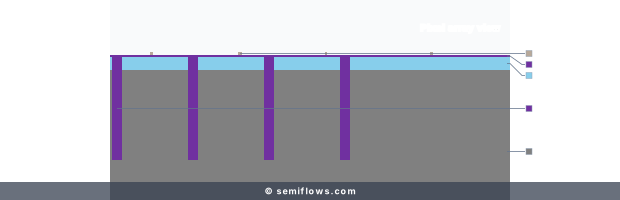
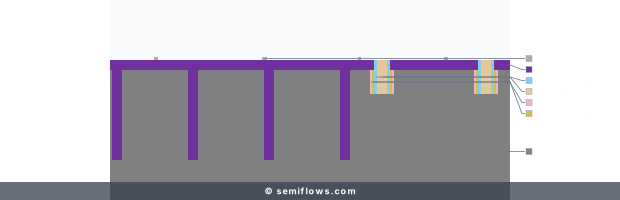
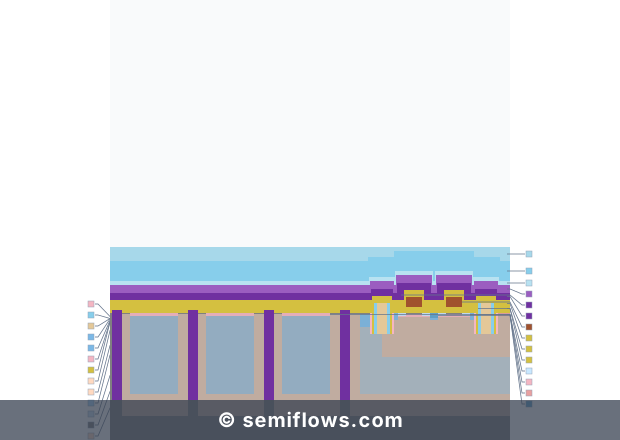
Chemical mechanical planarization (CMP), also widely referred to as chemical mechanical polishing, is a hybrid material-removal process that combines controlled chemical reactions with mechanical abrasion to produce exceptionally flat, smooth wafer surfaces across large substrate diameters .First developed at IBM and applied to oxide polishing in 1986, followed by tungsten polishing in 1988, CMP has since grown into arguably the most critical planarization technique in the semiconductor industry .Its ability to achieve both local and global planarity simultaneously—something that neither purely chemical etching nor purely mechanical grinding can accomplish—makes it indispensable at virtually every stage of modern integrated circuit (IC) fabrication .In today's multi-layer interconnect stacks, where more than ten metal levels may be built on a single die, even nanometer-scale surface height variations from one layer can accumulate and eventually push the depth of focus of lithographic exposure tools beyond their tolerance, causing print failures and yield loss .CMP eliminates this topographic buildup layer by layer, ensuring that each subsequent patterning step begins on a surface that is nearly perfectly flat .The process is applied in three broad manufacturing domains: front-end-of-line (FEOL) steps such as shallow trench isolation (STI), middle-of-line (MOL) contact and via polishing, and back-end-of-line (BEOL) copper and dielectric planarization .Understanding its fundamental mechanisms is therefore essential for any engineer designing or integrating advanced semiconductor processes .For a concrete look at how CMP slots into a complete device flow, see the 28nm Planar Flow and the 14nm FinFET process sequences .## Physics & Mechanism
The Chemical–Mechanical Synergy
The defining characteristic of CMP is that neither its chemical component nor its mechanical component is effective in isolation; it is their synergistic coupling that drives efficient, damage-minimized material removal .Chemically, slurry reagents—oxidants, bases, acids, or chelating agents depending on the target film—react with the wafer surface to form a chemically modified layer that is softer, more hydrated, or more oxidized than the underlying bulk material .For silicon dioxide, alkaline slurry chemistry promotes hydration, yielding a silicate-like surface layer that is mechanically weaker than the dense SiO₂ below it .For copper, oxidants in the slurry convert the surface Cu into Cu₂O or CuO, creating a passivated oxide skin .This chemically weakened surface layer is the key intermediate: it forms rapidly but does not dissolve appreciably in the slurry alone, so it accumulates until it is mechanically stripped .Mechanically, submicron abrasive particles—carried in the slurry and supported by the asperities of the polishing pad—transmit local contact stresses to the wafer surface under the applied downforce and relative rotational motion between the wafer carrier and the platen .These stresses shear off the chemically modified layer in a wear process that is far gentler than direct abrasion of the native material would be, because the passivation chemistry has already reduced surface bond strengths .The cycle then repeats: fresh bulk material is exposed, reacts with slurry chemistry to form a new modified layer, and is again mechanically removed .This cyclic reaction–removal mechanism is what distinguishes CMP from purely mechanical polishing and enables nanometer-scale planarity with sub-nanometer surface roughness .### Multiscale Nature of Material Removal
CMP operates across at least three distinct length scales simultaneously .At the atomic scale, surface reaction kinetics determine how quickly the chemically modified layer forms and how thoroughly bond strengths are reduced .At the particle scale, individual abrasive grains embedded in or supported by pad asperities transmit stress concentrations that cause micro-scale wear, plastic deformation, or shearing of the softened surface layer .The adhesion force between abrasive particles and the wafer surface—arising from van der Waals forces and electrical double-layer (DLVO) interactions in the aqueous slurry environment—can be comparable to or even exceed the Hertzian mechanical contact force under low-pressure, nanoscale-particle conditions, fundamentally influencing whether a particle slides over the surface, indents it, or adheres and lifts material through adhesive wear .At the wafer scale, the spatial distribution of pressure, relative sliding velocity, slurry film thickness, temperature, and pad topography across the entire 300 mm substrate determines within-wafer non-uniformity (WIWNU), the primary metric of planarization quality .### The Preston Equation and Its Limits
The classical starting point for modeling CMP material removal rate (MRR) is the Preston equation:
$$\text{MRR} = k_p \cdot P \cdot V$$
where P is the applied pressure between wafer and pad, V is the relative sliding velocity, and k_p is the Preston coefficient that encapsulates the combined chemical and mechanical efficiency of a given slurry–pad–film system .The Preston equation correctly captures the directional trends: increasing pressure or velocity increases removal rate .However, it was originally derived for purely mechanical polishing and therefore cannot describe the kinetics of passivation-layer formation, the time-dependent evolution of slurry chemistry at the interface, or the non-linear regimes that emerge at very high or very low pressures .More sophisticated multiscale models are required to fully predict CMP behavior for advanced materials and geometries .### Role of Slurry Chemistry and Particle–Surface Interactions
Slurry chemistry is not merely a passive enabler; it actively controls the selectivity of CMP .By formulating slurries with inhibitors that selectively passivate one material over another, dramatic removal-rate selectivity between co-exposed films can be achieved .For example, nitrogen-oxide compounds such as TEMPO can form passivating layers on germanium surfaces while leaving oxide surfaces reactive, yielding high germanium-to-oxide selectivity and minimizing recess of the protected material .The surface charge of abrasive particles and wafer films—quantified by their zeta potentials and governed by slurry pH relative to each material's isoelectric point (IEP)—determines electrostatic attraction or repulsion between abrasives and the polished surface, directly affecting particle adhesion, removal rate, and defect formation .Tuning slurry pH and additive chemistry to control these interfacial electrostatic forces is therefore a powerful lever for optimizing both MRR and surface quality .## Process Principles
How Key Parameters Directionally Affect Outcomes
Downforce (applied pressure): Increasing downforce raises the contact stress transmitted through pad asperities and abrasive particles, which directionally increases MRR according to the Preston relationship .However, beyond a threshold, elevated pressure can cause pad deformation that reduces real contact area non-uniformly across the wafer, worsening WIWNU, and it increases the risk of inducing surface scratches or subsurface damage by driving abrasive particles more deeply into the softened film .Relative velocity (platen and carrier rotation): Higher relative velocity between the wafer and pad increases the frequency of abrasive-particle interactions per unit time and promotes fresh slurry replenishment at the interface, both of which directionally increase MRR .Conversely, excessive velocity can thin the slurry hydrodynamic film and reduce contact area uniformity, coupling back to non-uniformity .Slurry chemistry and pH: The slurry's oxidant concentration and pH control the rate and completeness of surface chemical modification .Increasing oxidant activity accelerates passivation-layer formation, which can increase MRR up to the point where mechanical removal becomes rate-limiting .pH also shifts particle and surface zeta potentials, modulating adhesion forces between abrasives and the film being polished and therefore affecting both MRR and scratch risk .Abrasive particle characteristics: Larger particles transmit higher contact stresses at individual contact points, which can increase MRR but also elevates scratch probability .Higher particle concentration increases the number of active contacts per unit area, directionally raising MRR; however, agglomeration of particles at higher concentrations can create large, hard clusters that cause catastrophic scratching .Pad topography and conditioning: The polishing pad's surface roughness, porosity, and groove architecture govern slurry transport to the interface and the real contact area between pad asperities and the wafer .Pad conditioning—mechanically re-texturing the pad surface with a diamond-tipped conditioner disk—maintains pad asperity height and prevents pad glazing, which would otherwise cause MRR to decay over time as the pad surface becomes compacted and less able to carry slurry .Pad hardness controls how conformally the pad drapes over wafer topography: a harder pad planarizes more aggressively by concentrating pressure on high points, while a softer pad conforms more to topography and reduces local selectivity .Oxidation-reduction potential (ORP) management: The ORP of the polishing slurry and subsequent cleaning solution must be balanced; if the cleaning solution ORP is too close to the polishing slurry ORP, over-oxidation or insufficient passivation removal occurs, leading to residual surface defects .Maintaining an appropriate ORP ratio between the rinse and polish steps stabilizes surface chemical states during the critical transition from polishing to cleaning .## Challenges & Failure Modes
Dishing and Erosion
In metal CMP, particularly for copper damascene structures, dishing describes the bowl-shaped recess that forms at the center of wide metal lines because the relatively soft metal polishes faster than the surrounding dielectric and the pad conforms slightly into the metal recess .Erosion refers to the thinning of the dielectric field regions in densely patterned areas, where the combined removal of metal and dielectric reduces the overall stack height more than in isolated regions .Both phenomena arise from the spatial dependence of contact pressure and local pattern density and represent fundamental limitations of the Preston-equation-based pressure-distribution model .### Scratching and Subsurface Damage
Scratching is one of the most yield-limiting defects in CMP .It occurs when large or agglomerated abrasive particles, hard pad debris, or foreign contaminant particles are dragged across the wafer surface under sufficient force to plastically deform or fracture the polished film .The physical origin is straightforward: when local contact stress at a particle–surface asperity exceeds the yield strength of the surface material, irreversible damage occurs .Subsurface damage—amorphization, dislocation networks, or micro-cracking below the polished surface—can result from the same mechanism and may affect carrier mobility or leakage in subsequently formed devices .### Particle and Metallic Contamination
Residual abrasive particles remaining on the wafer after CMP adhere through electrostatic attraction between the particle surface charge and the film IEP under the prevailing slurry pH conditions .Metallic contaminants arise from dissolved metal ions in the slurry—from the polished film itself, from pad or retainer-ring wear debris—that re-deposit or form organo-metallic complexes on the wafer surface .Both contaminant types are yield detractors and, at sub-7 nm nodes, even sub-monolayer metallic contamination can degrade gate dielectric integrity or alter junction properties .### Within-Wafer Non-Uniformity
Achieving uniform material removal across a 300 mm wafer is physically constrained by the fact that every point on the wafer traces a different velocity trajectory relative to the pad, experiences different slurry film thickness due to centrifugal flow, and encounters different local contact pressure depending on wafer bow, chuck geometry, and retainer ring compliance .The transition from rigid wafer carriers to flexible membrane multi-zone carriers partially addresses this by allowing independent pressure control in different radial zones, but the fundamental challenge of achieving perfectly uniform contact stress remains .### Post-CMP Cleaning Challenges
Post-CMP cleaning must remove residual abrasive particles, metallic ions, and organic slurry additives without introducing new defects .Brush scrubbing with polyvinyl alcohol (PVA) brushes can cross-contaminate wafers if brush loading is not managed, while chemical cleaning solutions must be formulated to repel particle re-adhesion through electrostatic repulsion rather than merely diluting contaminants .Balancing the ORP between the polishing slurry and the rinse solution is an emerging approach to ensuring that surface chemistry is in a favorable state for efficient contaminant removal immediately after polishing .## Technology Node Evolution
28nm and Earlier: Establishing the Baseline
At the 28nm planar node, CMP was already well-established for STI, tungsten contacts, and copper interconnects .The primary planarization challenges were controlling copper dishing and dielectric erosion in BEOL, and achieving adequate STI height uniformity for threshold voltage control in FEOL .Slurry selectivity between copper and barrier liner materials (typically Ta/TaN) needed careful tuning to clear copper overburden while minimizing liner punch-through .### 14nm FinFET: Three-Dimensional Topography and New Materials
The transition to FinFET architecture at the 14nm node introduced substantially more complex CMP integration challenges .The three-dimensional fin structure means that CMP processes—particularly STI recess and fin reveal steps—must achieve angstrom-level height control to define the effective fin height, which directly sets transistor drive current and threshold voltage .MOL CMP for cobalt contact fill or tungsten plug formation must clear metal overburden from high-aspect-ratio contacts without inducing dishing into the narrow contact openings .The introduction of low-k dielectric materials with reduced mechanical strength also made BEOL CMP more challenging, as these porous or carbon-doped oxides are susceptible to mechanical delamination under the stresses of polishing .### 7nm and Beyond: Atomic-Scale Precision Requirements
At the 7nm FinFET node and below, CMP must achieve planarity at a scale where removal of even a few atomic layers more or less than intended can shift device performance outside specification .New materials introduced at these nodes—including cobalt and ruthenium as alternative metallization options, high-k dielectrics, and silicon-germanium (SiGe) channel materials in gate-all-around (GAA) nanosheet architectures—each present distinct CMP chemistry and selectivity challenges .For SiGe channel polishing, achieving high selectivity between SiGe and surrounding oxide without excessive recess requires inhibitor-based slurry strategies that selectively passivate SiGe while leaving oxide reactive .Defect density requirements at sub-7 nm nodes become extraordinarily stringent: even a single metallic contaminant atom in a critical gate region can cause device failure, placing extreme demands on both CMP slurry cleanliness and post-CMP cleaning efficacy .## Related Processes
CMP does not operate in isolation; it is tightly integrated with the process steps that precede and follow it .Upstream deposition processes such as chemical vapor deposition (CVD), physical vapor deposition (PVD), and atomic layer deposition (ALD) determine the incoming film thickness, surface topography, and stress state that CMP must planarize .High-density plasma (HDP) CVD, for instance, can partially fill and planarize high-aspect-ratio trenches before CMP completes the global planarization, reducing the total material removal burden .Downstream lithography is the direct beneficiary of CMP: a planar surface ensures that the entire exposure field is within the depth of focus of the scanner, allowing smaller features to be resolved faithfully .Etch processes for trench and via formation define the step height and pattern density that CMP must contend with, meaning that CMP process engineers must work closely with etch engineers to manage incoming topography .Electrochemical deposition (ECD) of copper overfills the damascene trenches and vias, and the quality of the ECD fill—void-free, low-defect copper—directly affects how cleanly the subsequent CMP step can remove the overburden without generating voids or inclusions at the polished surface .## Future Outlook
As the industry pushes toward gate-all-around nanosheet transistors, backside power delivery networks, and three-dimensional (3D) chip stacking, CMP faces a set of challenges that will require both incremental and fundamentally new approaches .Backside power delivery requires CMP of the wafer backside after thinning—a process that must achieve angstrom-level uniformity over an extremely thin, mechanically fragile substrate .Three-dimensional integration through wafer bonding demands CMP surface roughness at or below the sub-nanometer level across the full 300 mm wafer to enable direct oxide-to-oxide or hybrid bonding without voids .On the materials side, the continued introduction of novel metals (ruthenium, molybdenum) and dielectrics (ultra-low-k, air gaps) will require new slurry chemistries that can selectively remove these materials without damaging adjacent films .The development of abrasive-free and catalyst-enhanced slurries, which rely more heavily on controlled chemical dissolution rather than mechanical abrasion, may offer paths to lower defect densities for the most sensitive materials .In-situ endpoint detection and real-time process control—using optical, acoustic, or electrochemical sensing to monitor removal rate and surface state during polishing—are becoming increasingly important as the acceptable process window narrows at each successive technology node .Finally, the integration of machine learning and multiscale simulation tools promises to accelerate slurry and process optimization by enabling virtual process development that reduces the expensive empirical trial-and-error cycles historically required for CMP qualification .## References
1.Zhao, D.& Lu, X.(2013).Chemical mechanical polishing: Theory and experiment .Friction, 1(4), 306–326 (Engineering Practice).https://doi.org/10.1007/s40544-013-0035-x 2.Role of the Adhesion Force during Copper Chemical Mechanical Planarization (2018) . 3.Chemical Mechanical Planarization-Related to Contaminants: Their Sources and Characteristics (2020) . 4.Singh, R.K.& Bajaj, R.(2002).Advances in Chemical–Mechanical Planarization .MRS Bulletin, October 2002, 743 (Engineering Practice). 5.Plummer, J.D., Deal, M.D., & Griffin, P.B.(2000).Silicon VLSI Technology .Prentice Hall. 6.Hu, C.(2010).Modern Semiconductor Devices for Integrated Circuits .Prentice Hall. 7.System and a method for chemical mechanical planarization, and a composition kit, a rinse composition, and a planarization method used in the same .US-2025304841-A1 (2024) (Engineering Practice). 8.Chemical mechanical polishing method using slurry composition containing N-oxide compound .US-9881803-B2 (2013) (Engineering Practice).