Threshold voltage (Vth) is the gate voltage at which a MOS transistor turns on — conventionally, the onset of strong inversion in the simple MOS model, or a value extracted from a stated electrical criterion. It is not a hard boundary: below the extracted threshold, subthreshold current still flows. Vth sets the central trade-off of CMOS design — set it too high and drive current shrinks, degrading switching speed; set it too low and subthreshold leakage explodes, driving up static power and heat. Across billions of transistors, a fab hits its Vth targets with three levers: channel doping (the Vt-adjust implant), gate-stack capacitance and materials, and the gate metal's work function.
The Vt-Adjust Implant in the Flow
The most direct lever appears in production as a matched pair of steps: a lithography pass opens windows over the transistors to be adjusted, an ion implantation then places dopant atoms at a controlled depth and dose near the silicon surface, and a wet removal clears the implant screen oxide before the next module. The extra surface doping changes the depletion charge the gate must deplete before the channel inverts — shifting Vth without touching anything else in the device.
- Define the region: lithography selects which transistors receive the adjust dose — different device flavors on one wafer.
- Implant the dose: ion implantation sets the near-surface dopant concentration that shifts the threshold.
- Remove the screen oxide: a selective wet etch clears the implant oxide, handing a clean surface to the gate module that follows.
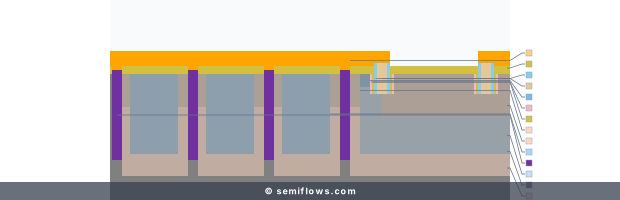
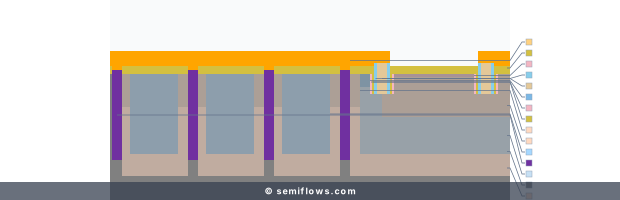
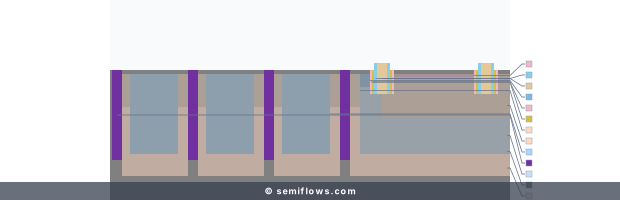
Real cross-sections from the free 40nm flow — the same steps this article's learning route links to.
Process checkpoint
Understand NMOS VT Adjust Implant Mask Lithography in context
See the lithography step that selects which transistors receive the threshold-adjust dose.
Process context for “Threshold Voltage (Vth): Definition and Control”: 40nm BSI CMOS Image Sensor · NMOS · Step 65
Physics & Mechanism
The gate dielectric is an insulator with almost no free carriers, so the applied gate voltage acts on the semiconductor through the electric field, bending the energy bands. The flat-band condition — zero surface field, flat bands — is the reference state for every bias analysis.
Reaching threshold means the gate voltage has overcome the work-function difference between gate and semiconductor bulk, compensated the fixed charges trapped at the interface, and bent the surface potential until the surface conductivity type inverts. Strong inversion is conventionally reached when the minority-carrier concentration at the surface equals the majority-carrier concentration in the bulk. The total gate voltage at that point divides between the drop across the oxide and the bend across the semiconductor depletion region; because oxide capacitance scales inversely with dielectric thickness, controlling that thickness is essential to targeting Vth . Adding donor or acceptor impurities moves the bulk Fermi level within the bandgap, changes the equilibrium carrier concentrations, and therefore changes the gate voltage required for inversion — the physics behind the implant lever above.
Process Principles
Manufacturing controls Vth through three integration levers, each with its own side effects:
- Channel doping: dedicated threshold voltage implant steps, delivered by ion implantation, optimize dose and energy to set near-surface dopant concentration — directly altering depletion charge and surface potential. The cost: impurity scattering degrades mobility as doping gets heavy.
- Gate-stack engineering: high-k metal gate dielectrics raise the equivalent oxide capacitance without physically thinning the insulator. Since scaling the oxide thickness increases gate tunneling leakage, high-k materials keep physical thickness (blocking tunneling) while increasing capacitive coupling and gate control.
- Work-function metals: rather than doping ever harder, HKMG integration selects gate metal alloys with specific work functions to set Vth targets — the standard approach at advanced nodes.
Challenges & Failure Modes
- Short-channel electrostatics: threshold roll-off compares channel lengths at specified bias; DIBL instead describes drain bias lowering the source-side barrier within one device, reducing extracted n-channel threshold and raising subthreshold current. The two are related but are not the same comparison — and because spacer dielectric, geometry, and junction profiles interact, a low-k spacer is no universal DIBL cure . The separate axes are laid out in SCE vs. DIBL.
- Body effect: substrate-to-source bias adds depletion charge and shifts the inversion threshold; low substrate doping and thin oxide minimize the shift.
- Bias temperature instability (BTI): defect generation and charge trapping in the dielectric or at the interface shift Vth over the transistor's lifetime, degrading circuit timing — reliability is a Vth problem, not just a fab problem.
From Principle to Production Flow
In the 40nm BSI CMOS Image Sensor flow, the NMOS threshold-adjust pair is exactly the sequence above: a threshold-adjust photolithography step selects the devices, the matching ion implantation step delivers the adjust dose, and the implant screen oxide is removed wet before gate oxidation takes over. From the 40nm flow overview you can walk these steps with real cross-sections — a free course flow, so step names, section states, and explanations are publicly visible.
Technology Node Evolution
At the 28nm planar node, planar MOSFETs fought severe short-channel effects while polysilicon gate depletion added unwanted series capacitance and shifted the effective work function. The industry answered with 3D structures at the 14nm FinFET node: the gate wraps three sides of a thin fin, dramatically improving electrostatic control and holding tight Vth control at scaled gate lengths. HKMG became standard alongside, letting Vth targets be set by work-function metal selection instead of heavy dopant modulation. In gate-all-around (GAA) nanosheets, threshold control moves fully to undoped or lightly doped channels surrounded by work-function metal stacks — low variability and superior subthreshold swing.
Related Processes
Vth engineering leans on its neighboring modules: the ultrathin gate dielectric is deposited by atomic layer deposition for atomic-scale thickness uniformity, directly setting the oxide capacitance; and after channel implants, rapid thermal processing and spike annealing — see rapid thermal annealing — activate the dopants into substitutional sites while minimizing diffusion, keeping the engineered dopant profile, and thus the designed threshold, stable through every later thermal budget.
References
Silicon VLSI Technology - Full
James D. Plummer, Michael D. Deal, Peter B. Griffin
Silicon VLSI Technology · ISBN 978-0130850379
Modern Semiconductor Devices for Integrated Circuits - MOSFETs in ICs
Chenming Hu
Modern Semiconductor Devices for Integrated Circuits · Ch7 MOSFETs in ICs